Macedonia
- Kind
- Region
- Today
- northern Greece
- Location
- securely identified (confidence 1000 of 1000)
When the place appears in the Bible
Map
Base map: Natural Earth (public domain), places after OpenBible.info (CC BY 4.0), © OpenStreetMap (ODbL) · All sources and licences
Notes and sources for this map
Location after OpenBible.info
Pictures
Excavation: remains from biblical times that have survived or been excavated
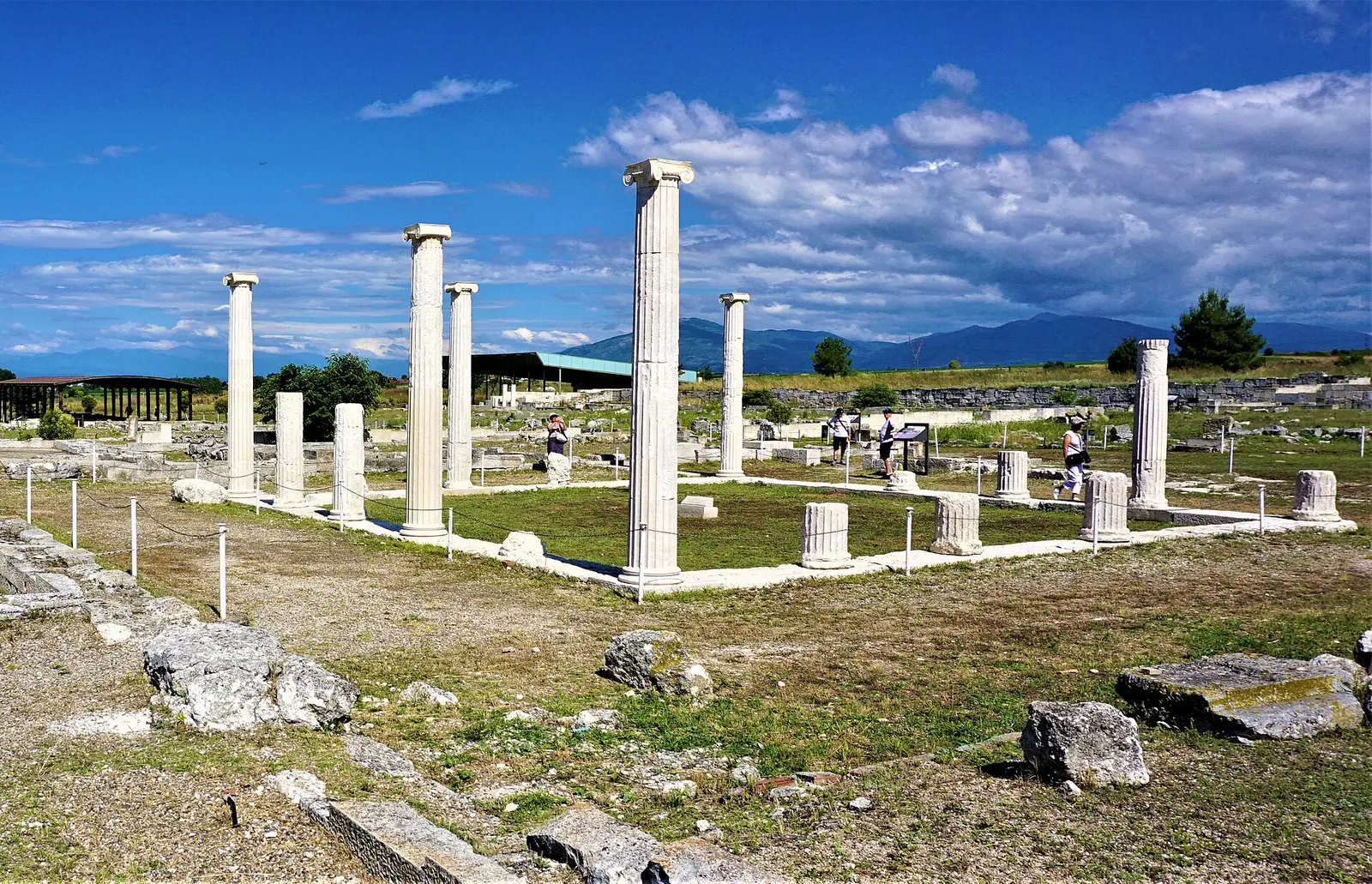
Photo credits
- Column remains at the archaeological site of Pella, capital of the ancient Macedonian kingdom. Excavation · 2018 · Joyofmuseums · CC BY-SA 4.0 · Source

Photos from Wikimedia Commons and the Matson Collection of the Library of Congress, resized. Tap a photo to enlarge it. Captions AI-assisted – How the texts are made
About the place
In New Testament times Macedonia was a Roman province in northern Greece with Thessalonica as its capital.1 Under Philip II and his son Alexander the Great, between 359 and 323 BC, the kingdom had become a world power.1 On his second missionary journey Paul answered the call of a Macedonian man he saw in a vision at night, and so the gospel reached Europe by way of Macedonia (Acts 16:9–12).1,2 Paul wrote letters to the churches in the Macedonian cities of Philippi and Thessalonica.1
History of Macedonia
Macedonia had been a kingdom since the seventh century BC; after Alexander’s death his successors divided the empire, and after some 150 unsettled years Macedonia came under Roman rule in 167 BC.1 The Romans first split the land into four districts, which Acts 16:12 may allude to, and made it a province in 14 BC.1,2 From AD 15 to 44 Macedonia was joined with Achaia and Moesia in one large province.1
Where Macedonia was
The province took in northern Greece and southern parts of what are now Albania and Bulgaria and of the former Yugoslav Republic of Macedonia.1 The land was known for gold, silver, timber and farmland and lay on the overland route between Asia and the West; the Via Egnatia, a paved road more than 800 kilometres long, ran from the Adriatic to the Aegean.1 Paul probably used it on his way through Neapolis and Philippi, then Amphipolis and Apollonia, to Thessalonica (Acts 16:11–12; 17:1).1,2
Macedonia in the New Testament
After the vision Paul crossed to Macedonia and worked above all in Philippi and Thessalonica (Acts 16:9–17:15).1,2 On his third journey, after a delay, he passed through Macedonia again, and after three months in Greece he returned once more by way of Macedonia (Acts 19:21–22; 20:1–3; 2 Corinthians 2:13).1,2
The churches in Macedonia
The Macedonian Christians gave generously to the collection for the poor in Jerusalem, and Paul praised their giving despite their deep poverty (Romans 15:26; 2 Corinthians 8:1–2).1,2 He held them up as an example of faith under pressure and praised their love for fellow believers (1 Thessalonians 1:7; 4:10).1,2 Macedonians such as Gaius and Aristarchus travelled with Paul and shared his work (Acts 19:29; 20:4; 27:2).1,2
Macedonia in the Bible
Macedonia appears in 28 sections across 7 books of the Bible – first in Acts 16:9, last in 1 Timothy 6:3. Most often in 2 Corinthians (12), 1 Timothy (6) and Acts (5).
Acts
mentioned: 16:9–10; 16:12; 18:5; 19:21–22; 19:29; 20:1; 20:3; 20:6
Romans
mentioned: 15:26
1 Corinthians
mentioned: 16:5
2 Corinthians
- 2 Corinthians 1:1–11 The God of All Comfort
- 2 Corinthians 1:12–2:17 Paul’s Change of Plans
- 2 Corinthians 3:1–18 Ministers of a New Covenant
- 2 Corinthians 4:1–18 Treasure in Jars of Clay
- 2 Corinthians 5:1–21 Ambassadors for Christ
- 2 Corinthians 6:1–7:1 Now Is the Day of Salvation
- 2 Corinthians 7:2–16 Paul’s Joy over the Corinthians
- 2 Corinthians 8:1–9:15 The Collection for Jerusalem
- 2 Corinthians 10:1–18 Paul Defends His Ministry
- 2 Corinthians 11:1–33 False Apostles and Paul’s Sufferings
- 2 Corinthians 12:1–10 My Grace Is Sufficient for You
- 2 Corinthians 12:11–13:14 Examine Yourselves
Philippians
mentioned: 4:15
1 Thessalonians
1 Timothy
- 1 Timothy 1:1–20 Against False Teaching
- 1 Timothy 2:1–15 Prayer for All People
- 1 Timothy 3:1–16 Overseers and Deacons
- 1 Timothy 4:1–16 A Good Servant of Christ
- 1 Timothy 5:1–6:2 Widows, Elders and Slaves
- 1 Timothy 6:3–21 Fight the Good Fight
Often mentioned together
Events at this place
- Mission to Macedonia and Greece
- Paul writes from Macedonia to the church in Corinth
- Paul writes to Timothy in Ephesus
References
- Tyndale Open Bible Dictionary – Article “Macedonia” · tyndaleopenresources.com
- Bible text: Acts 16:9–12; Acts 17:1; Acts 19:21–22; Acts 20:1–3; 2 Corinthians 2:13; Romans 15:26; 2 Corinthians 8:1–2; 1 Thessalonians 1:7; 1 Thessalonians 4:10; Acts 19:29; Acts 20:4; Acts 27:2